
Myopia Awareness Week 2026
18-24th May
Myopia Awareness Week takes place on 18-24 May 2026, with the global theme “Start Early, Protect Vision for Life”. The focus of this campaign is to identify myopia in children early, to reduce the risk of lifelong eye conditions.
Myopia is an eye condition that causes unclear distance vision - often referred to as short-sightedness or near-sightedness. Children with myopia can usually see well up close (like reading a book), but things in the distance, such as the classroom whiteboard or TV screen, appear blurry. Myopia occurs when the eye grows too quickly and too long, or the cornea is too curved, which causes light to focus in front of the retina, instead of directly on it.
Myopia is becoming increasingly common. Around 30% of the world population was myopic in 2016, and that figure is expected to rise to 50% (5 billion myopes) by 2050, and 1 billion of those will be high risk of sight-threatening disease. Myopia is common and increasing in prevalence, highlighting the importance of monitoring and early management.
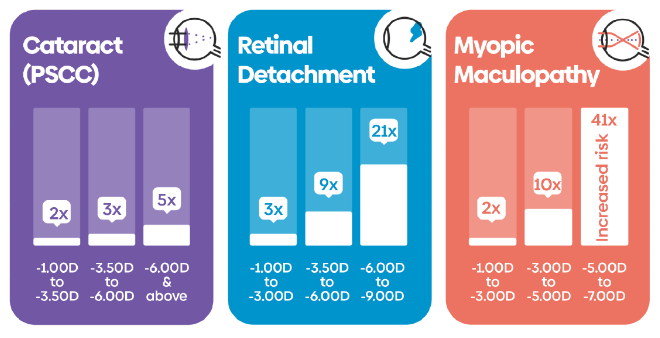
Higher levels of myopia are strongly linked to higher risk of cataract, retinal detachment, and myopic maculopathy. Even an increase of -1.00 dioptre for a myope doubles the risk of macula maculopathy and cataract, and triples the risk of retinal detachment compared to an emmetrope (someone that does not have a corrective prescription). The below tables indicate the increased risk of serious eye conditions for myopes at increasing levels of myopic correction.
Risk factors for myopia include family history of myopia, ethnicity, environmental factors like less time spent outdoors, and excessive near work (like reading or screen-time)
If you notice that your child is struggling to see in the distance, or moves closer to see things they could have myopia. As parents, there are some behavioural adjustments your child can make to reduce the risk of myopia developing:
Ensure children are operating at the optimal working distance for reading, known as the Harmon distance, which is the distance from your fist held at the eye to your elbow.
Spending at least 2 hours outside every day.
No more than 2 hours screen time per day after school.
Taking frequent breaks from near work following the 20-20-20 rule: every 20 minutes take a break for 20 seconds and look at something 20 feet, or 6 metres, away.
With new developments in myopia intervention technologies, myopia progression can be slowed, and reduce the risk of sight-threatening eye disease in later life. At Windsor Optometry, we offer myopia control spectacle lenses Stellest 2.0, which slows myopia progression down by 67%, MiSight contact lenses, and low dose atropine eyedrops which both slow progression by 50%. While dioptres of myopia are easily measurable and an indicator of risk, ultimately, myopia control is about axial length control. If we can keep myopia below -3.00D and axial length below 26 mm it is a huge modifying factor for lifelong risk of visual impairment. We closely monitor the axial length and myopic prescription of our children every 3-6 months to measure effectiveness of the various treatments and intervene in any myopic shifts as early as possible.
If you think your child might be at risk of developing myopia, book an appointment on (02) 4577 3471 or at www.windsoroptometry.com.au/contact-us for a Comprehensive Eye Examination.
“Outdoor play keeps myopia away!”

For more resources on Myopia and your child visit https://www.mykidsvision.org/
Saw, J. (2025) Explaining how myopia control works to parents, Myopia Profile. Available at: https://www.myopiaprofile.com/articles/explaining-how-myopia-control-works-to-parents (Accessed: 18 May 2026).